


What Do Physicians Really Want to Know Before Relocating to a New City?
Physicians interviewing for residency or an attending role want to know what daily life will actually feel like: commute times, housing costs relative to salary, whether the pace fits their schedule, and whether the city works for a partner or family too. Programs are built to sell the position. They are not built to answer those questions, and most physicians are too busy or too cautious during the process to ask them directly.
You have sat through the tour. You have heard about the program's reputation, its case volume, its research output. What you have not heard much about is where you would actually live, what your commute would look like on a 6 a.m. shift, or whether the neighborhood near the hospital is even one you would want to come home to.
That gap is not an oversight. Programs are built to sell you on the training. Nobody on that interview committee is positioned to tell you about the city itself, and most physicians are too polite, too pressed for time, or too early in the process to push for that information directly.
What Programs Tell You vs. What You Actually Need to Know
A program will walk you through faculty bios, match rates, and call schedules. What it usually will not cover is cost of living against your expected salary, what a reasonable commute looks like at shift-change hours, or which neighborhoods actually put you close enough to the hospital to matter on your worst call night.
This is not a small gap. The American Medical Association's research on Match rank-order lists found that desired geographic location was cited by 89 percent of allopathic senior medical students as a top factor, second only to overall fit. And more than half of residents end up practicing in the state where they trained. The place you choose now is often the place you build a career and a life. It deserves more than a hallway conversation and a hospital-provided map.
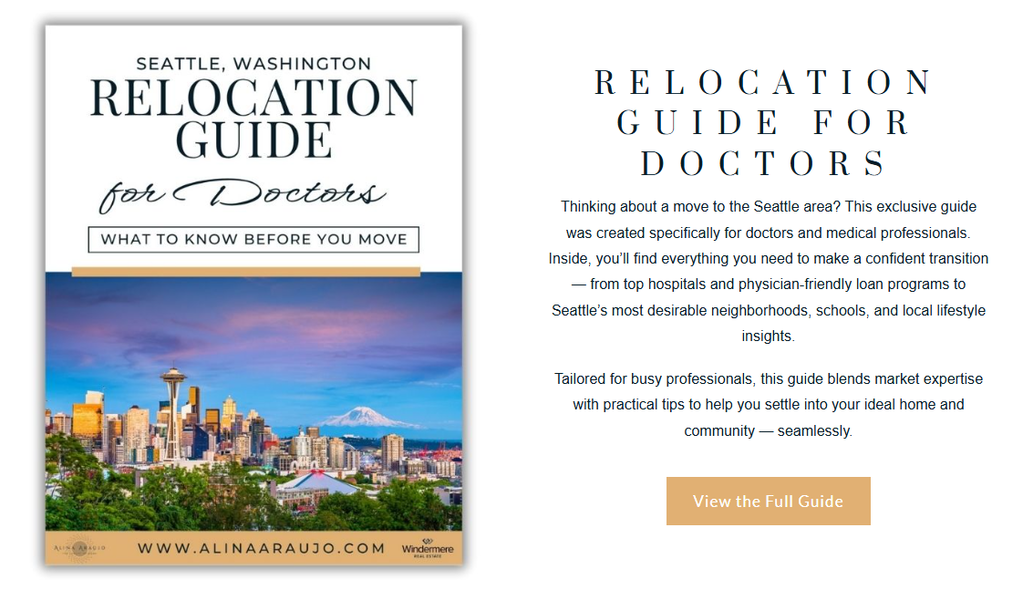
Physicians relocating to Greater Seattle for a residency or attending position rarely have time to research a city the way they would research a diagnosis. A relocation-focused strategy session with Alina Araujo replaces the guesswork with a direct answer, tailored to your program, your timeline, and your budget. See my Free Relocation Guide for Doctors here or Start that conversation here.
The Questions You're Too Busy or Too Cautious to Ask
Some of the most useful questions never make it into an interview because they feel too personal, too practical, or too far outside the scope of a program visit. You are not going to ask your interviewer what a 20-minute commute actually looks like at 6:45 a.m., or whether a starting attending salary stretches further in one neighborhood than another. You are not going to ask whether the city has a social scene for someone who works 60-hour weeks, or whether your spouse will be able to find work in their own field.
These are the questions that determine whether you thrive in a city or just tolerate it. On the Eastside, that means understanding how Kirkland, Bothell, Kenmore, and Woodinville each sit relative to major employers like Overlake Medical Center, Evergreen Health, and UW Medicine's northern facilities, and how that translates into a real commute rather than a Google Maps estimate that ignores rush hour on I-405.
What Makes a City Livable, Not Just Functional
A functional city has hospitals, housing, and highways. A livable one has the things that make a demanding career sustainable: trail access after a hard shift, a lake to clear your head by, a downtown you can walk to without getting back in the car.
Greater Seattle's Eastside offers both. You can be on the Cross Kirkland Corridor or the Burke-Gilman Trail within minutes of home. Lake Washington and the Kenmore waterfront give you water access most cities cannot match. Downtown Kirkland and downtown Bothell offer restaurants and a slower pace without pulling you far from King County's major medical centers. This is the Pacific Northwest lifestyle physicians describe when they talk about staying somewhere long after their training ends: mountain views on a clear commute, outdoor access that does not require a weekend trip, and a home base that actually recovers you between shifts.
None of that shows up on a program's website. It shows up when you walk the neighborhood yourself, or when someone who knows the area walks you through it honestly.
How a Relocation Specialist Fills the Gap
This is where a physician relocation specialist earns their place in your process, not after you have matched or accepted an offer, but while you are still deciding. A good relocation partner answers the questions you have not had time to ask: realistic commute times by neighborhood, how far your salary goes in each city, which areas put you closest to your hospital system, and what daily life actually looks like for someone working your hours.
You are not just choosing a program. You are choosing where you will live, and often for longer than the length of your training. Getting an honest answer before you decide, rather than after you have signed a lease sight unseen, changes how the whole transition feels.
Frequently Asked Questions
What should physicians ask about a city before ranking a residency program? Beyond the program itself, ask about realistic commute times from likely neighborhoods, cost of living relative to a resident or attending salary, and what daily life looks like for someone working long, irregular shifts. A relocation specialist can answer these before you rank the program, not after.
Is the Eastside a good fit for physicians relocating to Seattle? Bothell, Kirkland, Kenmore, and Woodinville sit close to major Eastside employers and several King County medical centers, with trail access, waterfront, and a quieter pace than downtown Seattle. For physicians who want outdoor access and a shorter commute without sacrificing proximity to hospitals, it is worth serious consideration.
What should I expect when relocating to Greater Seattle as a physician? Expect a compressed timeline between accepting a position and needing housing, a competitive market that rewards preparation, and real variation in commute and cost of living across the Eastside and North Seattle. Working with a specialist familiar with physician timelines removes most of the guesswork.
Every one of these questions has an honest answer. You just have to know who to ask. If you are heading into interview season or already have an offer in hand, request a private relocation strategy session with Alina Araujo. You will get straight answers about neighborhoods, commutes, and cost of living from someone who has guided physicians through this exact move, not a hospital-provided welcome packet. Serving Bothell, Kenmore, Woodinville, Kirkland, and Greater Seattle.
About Alina Araujo Alina Araujo is a Real Estate Advisor at Windermere Real Estate/East in Kirkland, Washington, serving Bothell, Kenmore, Woodinville, Kirkland, and North Seattle. With over 13 years of experience and a background in mortgage lending and hospitality, she brings a unique combination of empathy, strategy, and local expertise to every transaction. Alina is fluent in English, Spanish, and Russian and is a Certified Luxury Home Marketing Specialist, Relocation Specialist, and Master Certified Negotiation Expert. Reach her at (206) 353-2290 or alinaaraujo.com.
Check out this article next